
Quick Summary
- What it is: Your thyroid doesn’t work alone—it interacts with every other hormone in your body (estrogen, cortisol, testosterone, insulin)
- Key symptoms: Unexplained fatigue, weight gain, brain fog, hair loss, irregular periods, and feeling cold can all signal thyroid-hormone imbalances
- Testing matters: Standard TSH-only tests miss many thyroid problems; comprehensive panels reveal the full picture
- Treatment options: Beyond synthetic T4, options include T3-containing medications, natural desiccated thyroid, and addressing root causes
- Next step: Schedule comprehensive thyroid and hormone testing at Optimal Health & Wellness (Richmond, VA)
Introduction
You’ve been to three different doctors. You’ve described the exhaustion that makes getting out of bed feel like climbing a mountain. The weight that keeps creeping up despite eating less. The brain fog so thick you can barely finish a sentence. The hair falling out in clumps. The feeling that your body has betrayed you.
And each time, you hear the same thing: “Your thyroid labs look normal.”
But you don’t feel normal. Not even close.
Here’s what those doctors might not be telling you: thyroid function doesn’t exist in isolation. Your thyroid hormones interact intimately with every other hormone in your body—estrogen, progesterone, testosterone, cortisol, insulin. When one system falters, others are forced to compensate, struggle, or eventually fail. This interconnected web means that thyroid dysfunction can cause widespread hormonal chaos, and conversely, other hormone imbalances can impair thyroid function.
Understanding this connection isn’t just academic—it’s the key to finally getting the comprehensive treatment you need.
Understanding Your Thyroid: The Master Metabolism Regulator
Your thyroid is a small, butterfly-shaped gland located at the base of your neck. Despite its modest size, it wields enormous influence over your body’s metabolism—the rate at which your cells convert nutrients into energy and perform their various functions.
How the Thyroid Works
Your thyroid produces two primary hormones:
T4 (Thyroxine): The inactive storage form of thyroid hormone. Your thyroid produces mostly T4, which circulates through your bloodstream waiting to be converted into the active form.
T3 (Triiodothyronine): The active form that actually enters your cells and regulates metabolism. About 20% of T3 comes directly from your thyroid; the remaining 80% is converted from T4 in your liver, kidneys, and other tissues.
This production is regulated by a feedback loop involving your hypothalamus and pituitary gland:
- Your hypothalamus produces TRH (thyrotropin-releasing hormone)
- TRH signals your pituitary to produce TSH (thyroid-stimulating hormone)
- TSH tells your thyroid to produce T4 and T3
- When thyroid hormone levels are adequate, this signals the hypothalamus and pituitary to reduce TRH and TSH production
This elegant system works beautifully—until it doesn’t.
Types of Thyroid Dysfunction: More Than Just Hypothyroidism
When we talk about thyroid problems, most people think of hypothyroidism (low thyroid function). But thyroid dysfunction comes in several forms, each with distinct implications for your overall hormone balance.
Hypothyroidism (Underactive Thyroid)
This is the most common thyroid disorder. Estimates suggest it affects approximately 5% of Americans. In hypothyroidism, your thyroid doesn’t produce enough hormone to meet your body’s needs.
- Primary hypothyroidism: The thyroid gland itself is the problem (most common cause: Hashimoto’s thyroiditis, an autoimmune condition)
- Secondary hypothyroidism: The pituitary doesn’t produce enough TSH to stimulate the thyroid
- Tertiary hypothyroidism: The hypothalamus doesn’t produce enough TRH (rare)
Hyperthyroidism (Overactive Thyroid)
Less common but equally problematic, hyperthyroidism occurs when your thyroid produces too much hormone, accelerating your metabolism excessively. The most common cause is Graves’ disease, another autoimmune condition.
Subclinical Thyroid Dysfunction
This is where things get tricky. In subclinical hypothyroidism, your TSH is elevated but your T4 and T3 are still in the “normal” range. You may have significant symptoms, but many doctors dismiss these cases as “not thyroid-related.”
Studies suggest subclinical hypothyroidism affects an estimated 4-10% of adults and can progress to overt hypothyroidism over time. More importantly, people with subclinical hypothyroidism frequently experience symptoms and metabolic consequences that impact their quality of life.
Thyroid Conversion Problems
Sometimes your thyroid produces adequate T4, but your body struggles to convert it into active T3. This can happen due to nutritional deficiencies (selenium, zinc, iron), chronic inflammation, liver dysfunction, or medication interference. Standard thyroid testing often misses this nuance.
Hashimoto’s Thyroiditis
The most common cause of hypothyroidism in developed countries, Hashimoto’s is an autoimmune condition where your immune system attacks your thyroid gland. The gland becomes inflamed and gradually loses its ability to produce hormones. Hashimoto’s requires a different treatment approach than simple hypothyroidism because the underlying immune dysfunction must also be addressed.
The Intricate Connection Between Thyroid and Other Hormones
Here’s where understanding gets crucial: your thyroid doesn’t operate independently. It’s part of an interconnected endocrine system where each hormone influences others.
Thyroid and Sex Hormones (Estrogen, Progesterone, Testosterone)
The relationship between thyroid hormones and sex hormones is bidirectional and complex:
Estrogen dominance and thyroid: High estrogen levels (whether from excess estrogen or inadequate progesterone to balance it) increase levels of thyroid-binding globulin (TBG). TBG binds to thyroid hormones in your blood, making them inactive and unavailable to your cells. Your total thyroid hormone levels might look fine on tests, but your free thyroid hormone—the portion that actually works—is too low. This is why many women develop thyroid symptoms during pregnancy, when taking birth control pills, or during perimenopause when estrogen can spike relative to progesterone.
Low thyroid affects sex hormone production: Your thyroid hormones are needed for the liver to clear excess estrogen from your body. When thyroid function is low, estrogen clearance slows, leading to estrogen dominance—which further suppresses thyroid function, creating a vicious cycle. Hypothyroidism also reduces sex hormone-binding globulin (SHBG) production, which can lead to elevated free testosterone in women (causing acne, hair loss, and PCOS-like symptoms) or increased estrogen activity.
Thyroid and fertility: Both hypo- and hyperthyroidism can disrupt ovulation and menstrual cycles, making conception difficult. Research demonstrates that even subclinical thyroid dysfunction affects fertility outcomes and increases miscarriage risk.
Thyroid and Cortisol (Your Stress Hormone)
The thyroid-adrenal connection is profound and often overlooked:
Chronic stress suppresses thyroid function: Prolonged elevation of cortisol (your primary stress hormone) decreases the conversion of T4 to active T3 and increases conversion to reverse T3 (an inactive form that blocks thyroid receptors). Chronic stress also reduces TSH production, so your thyroid receives less signal to produce hormones.
Low thyroid increases cortisol: When thyroid function drops, your body compensates by increasing cortisol production to maintain energy levels. This creates additional stress on your adrenal glands, potentially leading to adrenal dysfunction.
The result: Many people with chronic stress develop thyroid problems, and many people with thyroid problems experience worsening stress responses. Treating one without addressing the other often leads to incomplete recovery.
Thyroid and Insulin (Blood Sugar Regulation)
Thyroid hormones significantly influence glucose metabolism and insulin sensitivity:
Hypothyroidism impairs insulin sensitivity: Low thyroid function makes your cells less responsive to insulin, requiring higher insulin levels to manage blood sugar. This can lead to insulin resistance, weight gain (especially abdominal fat), and increased risk of type 2 diabetes.
Insulin resistance affects thyroid function: Elevated insulin increases inflammation and can interfere with thyroid hormone conversion and receptor sensitivity.
Clinical significance: If you have insulin resistance or type 2 diabetes along with thyroid symptoms, treating the thyroid alone won’t fully resolve metabolic issues. Both must be addressed simultaneously.
Recognizing Thyroid Hormone Imbalance: Symptoms That Affect Your Whole Body
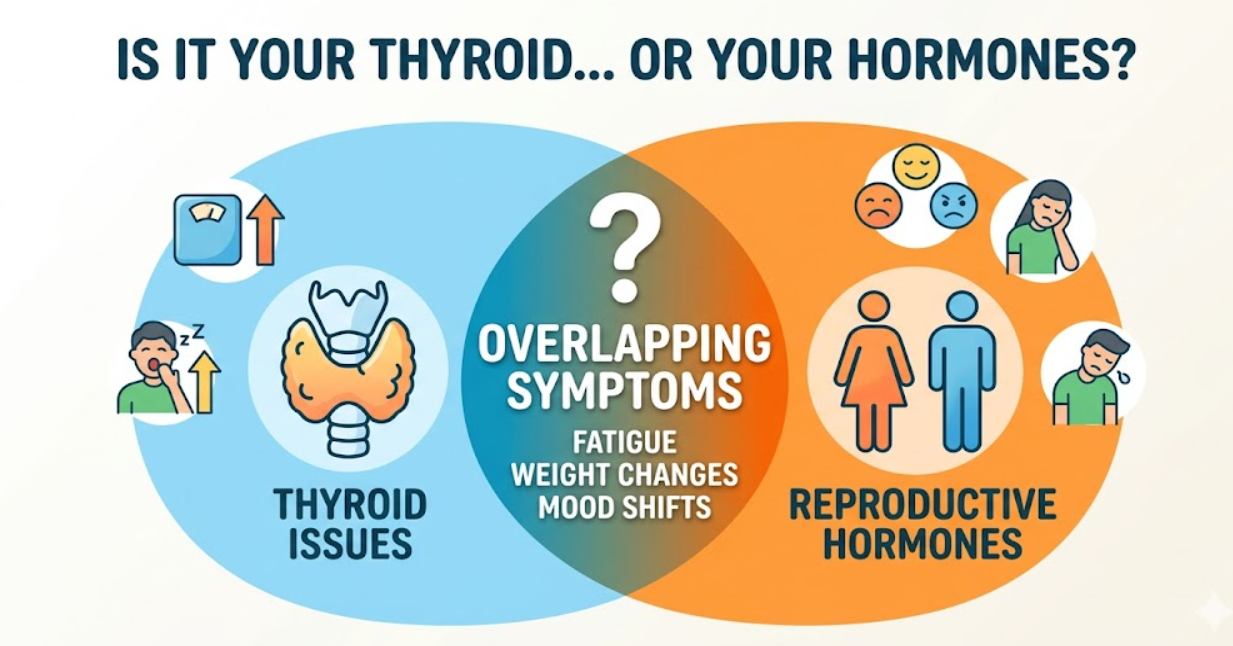
Thyroid dysfunction creates a constellation of symptoms that affect virtually every body system. Because these symptoms overlap with other hormone imbalances, accurate diagnosis requires comprehensive evaluation.
Hypothyroidism Symptoms
Metabolic symptoms:
- Unexplained weight gain or inability to lose weight despite diet and exercise
- Persistent fatigue and low energy
- Always feeling cold (cold intolerance)
- Slowed heart rate
- Constipation
Cognitive and emotional symptoms:
- Brain fog and difficulty concentrating
- Memory problems
- Depression or low mood
- Anxiety
Physical symptoms:
- Dry skin and hair
- Hair thinning or loss (including eyebrows)
- Brittle nails
- Puffy face, especially around eyes
- Hoarse voice
- Muscle weakness and aches
- Joint pain and stiffness
Reproductive symptoms (women):
- Heavy or irregular menstrual periods
- Fertility problems
- Low libido
Reproductive symptoms (men):
- Low testosterone symptoms
- Erectile dysfunction
- Decreased libido
Hyperthyroidism Symptoms
While less common, hyperthyroidism creates its own set of debilitating symptoms:
- Unintended weight loss despite increased appetite
- Rapid or irregular heartbeat (palpitations)
- Anxiety and irritability
- Tremors in hands and fingers
- Increased sweating and heat intolerance
- More frequent bowel movements
- Difficulty sleeping
- Fatigue and muscle weakness
- Light or irregular menstrual periods
- Eye problems (especially with Graves’ disease)
Comprehensive Thyroid Testing: What You Actually Need
Here’s where many conventional approaches fall short: they test only TSH, or TSH and T4, declaring your thyroid “fine” if these fall within reference ranges. But comprehensive thyroid assessment typically benefits from a broader panel.
Essential Thyroid Tests
TSH (Thyroid-Stimulating Hormone):
- The first-line screening test
- Elevated TSH suggests hypothyroidism (your pituitary is working hard to stimulate an underperforming thyroid)
- Low TSH suggests hyperthyroidism (your pituitary is backing off because the thyroid is overproducing)
- Important note: “Normal” TSH range is typically 0.5-4.5 mIU/L, but optimal is generally 0.5-2.5 mIU/L. Many people feel best with TSH between 1-2.
Free T4:
- Measures the unbound, active T4 available to your cells
- More useful than total T4, which includes bound (inactive) hormone
Free T3:
- The active thyroid hormone that actually regulates metabolism
- Critical to measure because some people have normal T4 but inadequate T3 conversion
- Often the missing piece in people with hypothyroid symptoms but “normal” TSH and T4
Reverse T3:
- An inactive form of T3 that blocks thyroid receptors
- Elevated in chronic stress, inflammation, liver dysfunction, and certain nutrient deficiencies
- High reverse T3 can cause hypothyroid symptoms even when T4 and T3 appear adequate
Thyroid Antibodies:
- Anti-TPO (thyroid peroxidase antibodies): Elevated in Hashimoto’s thyroiditis
- Anti-thyroglobulin antibodies: Also elevated in Hashimoto’s
- TSI (thyroid-stimulating immunoglobulins): Elevated in Graves’ disease
- Testing antibodies identifies autoimmune thyroid disease, which requires specific treatment approaches
Additional Tests to Consider
- Thyroid ultrasound: Visualizes thyroid structure, identifies nodules or inflammation
- Iodine levels: Deficiency or excess both impair thyroid function
- Selenium, zinc, iron: Essential nutrients for thyroid hormone production and conversion
- Vitamin D: Deficiency associated with autoimmune thyroid disease
- Sex hormones: To assess thyroid-hormone interactions
- Cortisol: To evaluate adrenal-thyroid axis
At Optimal Health & Wellness (Richmond, VA), we perform comprehensive thyroid panels as part of our hormone optimization programs, recognizing that effective treatment requires understanding the complete hormonal picture, not just isolated thyroid markers.
Treatment Approaches: Beyond Synthetic T4
The standard medical approach to hypothyroidism is levothyroxine (synthetic T4) monotherapy. For many people, this works adequately. For others—particularly those with conversion problems or complex hormonal imbalances—it’s not enough.
Levothyroxine (T4-Only Treatment)
This synthetic T4 (Synthroid, Levoxyl, generic versions) remains the first-line treatment and works well for many patients. It’s consistent, well-studied, and usually covered by insurance.
Advantages: Proven efficacy, long half-life (stable blood levels), widely available.
Limitations: Relies on your body successfully converting T4 to T3, which doesn’t happen optimally for everyone. If you have conversion problems, you may have adequate T4 levels but remain symptomatic due to insufficient T3.
T3-Containing Medications
For patients who don’t fully respond to T4-only treatment, adding T3 can be very helpful for some patients:
Synthetic T3 (Cytomel, liothyronine): Pure T3 medication that can be added to T4 therapy or used alone in specific situations.
Combination T4/T3 medications: Some patients do well on combinations of synthetic T4 and T3, dosed to match their individual needs.
Natural Desiccated Thyroid (NDT): Derived from porcine (pig) thyroid glands, NDT contains both T4 and T3 in a fixed ratio, along with small amounts of other thyroid hormones. Brands include Armour Thyroid, Nature-Throid, and WP Thyroid. Some patients report feeling better on NDT than on synthetic medications, though research comparing outcomes is limited.
Compounded Thyroid Medications
For patients with sensitivities to commercial formulations or who need very specific dosing ratios, compounding pharmacies can create custom thyroid medications. This allows for precise T4:T3 ratios tailored to individual needs.
Addressing Root Causes
Effective thyroid treatment goes beyond hormone replacement:
For Hashimoto’s: Address autoimmune triggers through dietary modifications (many patients benefit from gluten elimination), stress management, gut health optimization, and adequate selenium supplementation.
For conversion problems: Optimize selenium, zinc, and iron status; reduce inflammation; support liver function; and manage stress.
For thyroid-sex hormone interactions: Balance sex hormones through lifestyle modifications, bioidentical hormone therapy, or both.
Lifestyle and Nutritional Support
Certain nutrients are essential for optimal thyroid function:
- Iodine: Essential for thyroid hormone production (but excess can worsen autoimmune thyroid disease)
- Selenium: Required for T4 to T3 conversion and has anti-inflammatory properties
- Zinc: Supports thyroid hormone production and conversion
- Iron: Deficiency impairs thyroid function
- Vitamin D: Supports immune function and thyroid health
- Omega-3 fatty acids: Reduce inflammation
Important: These nutrients are examples of what we often evaluate in our patients; they are not one-size-fits-all prescriptions. Dosing (especially iodine and iron) should always be individualized based on labs and medical history—work with your provider at Optimal Health & Wellness before starting new supplements.
Finding Thyroid Treatment in Richmond: What to Look For
If you’re in the Richmond area searching for comprehensive thyroid care, here’s what to look for in a provider:
- Comprehensive testing approach: Look for practitioners who test beyond just TSH, including Free T3, Free T4, Reverse T3, and antibodies
- Willingness to treat symptoms, not just labs: Many providers recognize that optimal thyroid function means you feel well, not just that your labs fall within reference ranges
- Understanding of thyroid-hormone connections: Your thyroid doesn’t work in isolation. Effective treatment requires addressing all hormonal imbalances simultaneously
- Multiple treatment options: Providers should be open to T3-containing medications, NDT, or compounded options if T4-only treatment isn’t sufficient
- Functional medicine perspective: Often, the best outcomes come from addressing root causes—nutrient deficiencies, inflammation, stress, gut health—alongside hormone replacement
At Optimal Health & Wellness (Richmond, VA), we specialize in comprehensive hormone optimization, including thyroid hormone balance. Our approach recognizes that thyroid dysfunction rarely exists in isolation and requires treatment that addresses your complete hormonal ecosystem.

FAQ: Common Questions About Thyroid and Hormone Balance
Q: Can my thyroid be the problem even if my TSH is normal?
A: Absolutely. For many patients, more complete testing is the key to understanding what’s really going on. You can have normal TSH with low Free T3, high Reverse T3, or conversion problems that cause symptoms. You can also have subclinical hypothyroidism (slightly elevated TSH with “normal” T4/T3) that causes significant symptoms.
Q: Why do I still have symptoms even though I’m taking levothyroxine?
A: Several possibilities: your dose may be inadequate, you may have a conversion problem (not making enough T3 from T4), you may have other hormone imbalances affecting your thyroid function, you may have nutritional deficiencies impairing thyroid function, or you may simply respond better to T3-containing medications or NDT.
Q: Can hormone replacement therapy (estrogen/progesterone) affect my thyroid?
A: Yes. Estrogen increases thyroid-binding globulin, which can reduce free thyroid hormone availability. If you start hormone replacement therapy and develop hypothyroid symptoms, you may need thyroid medication adjustment. This is why monitoring both thyroid and sex hormones together is crucial.
Q: How long does it take to feel better after starting thyroid treatment?
A: Most people notice some improvement within 2-4 weeks, with continued improvement over 2-3 months as levels stabilize. However, finding your optimal dose and medication type sometimes requires several adjustments over 6-12 months.
Q: Should I take my thyroid medication at a specific time?
A: Yes. Take thyroid medication on an empty stomach, ideally 30-60 minutes before breakfast, with water only. Avoid taking it with coffee, which can impair absorption. Separate thyroid medication from calcium, iron supplements, and antacids by at least 4 hours.
Q: Can I reverse hypothyroidism naturally without medication?
A: It depends on the cause. If hypothyroidism is caused by severe nutrient deficiency, addressing that deficiency may restore function. If it’s caused by Hashimoto’s or other autoimmune disease, you may slow progression through lifestyle changes but likely won’t reverse established damage. Many people with hypothyroidism need medication, but lifestyle optimization and addressing root causes can minimize the required dose.
Take Control of Your Thyroid and Hormone Health
Living with undiagnosed or inadequately treated thyroid dysfunction diminishes every aspect of your life. The fatigue, weight struggles, brain fog, mood problems, and physical symptoms aren’t “just in your head”—they’re the result of a treatable hormonal imbalance.
But here’s what’s crucial to understand: your thyroid doesn’t work alone. Effective treatment requires a comprehensive approach that addresses all your hormones—thyroid, sex hormones, adrenals, and metabolic hormones—as an interconnected system.
You deserve more than being told your labs are “normal” when you feel anything but. You deserve a provider who will listen to your symptoms, perform comprehensive testing, and work with you to find the treatment approach that restores your vitality.
Get Comprehensive Thyroid and Hormone Testing in Richmond
At Optimal Health & Wellness (Richmond, VA), we specialize in comprehensive hormone optimization, including thorough thyroid evaluation and treatment. We understand that your thyroid is just one piece of your hormonal health puzzle.
Ready to finally get answers about your thyroid and hormone health? Schedule your consultation today.
Our Approach Includes:
- Complete thyroid panel testing (TSH, Free T4, Free T3, Reverse T3, antibodies)
- Comprehensive hormone evaluation to identify thyroid-hormone interactions
- Nutritional assessment to identify deficiencies affecting thyroid function
- Personalized treatment plans using the most appropriate medication for your needs
- Ongoing monitoring and optimization to ensure you achieve and maintain optimal thyroid function
- Integration with bioidentical hormone therapy when other hormonal imbalances are present
Contact Us
Optimal Health & Wellness Center
1630 Wilkes Ridge Parkway Suite 105
Henrico, VA 23233
(804) 280-0282
Don’t spend another day feeling exhausted, foggy, and frustrated. Contact Optimal Health & Wellness now to schedule your comprehensive thyroid and hormone evaluation.
Your thyroid is trying to tell you something. Let us help you listen—and respond with the comprehensive treatment you deserve.
About the Author
This article was developed by the hormone optimization specialists at Optimal Health & Wellness (Richmond, VA). Our practice focuses exclusively on comprehensive hormone balance, including thyroid optimization, bioidentical hormone replacement therapy, and integrated approaches to hormonal health. Our medical team includes board-certified practitioners with specialized training in endocrinology and functional medicine approaches to hormone optimization.
Medical Disclaimer
This article is for informational purposes only and does not constitute medical advice. Thyroid disorders are serious medical conditions that require professional diagnosis and treatment. Always consult with a qualified healthcare provider before starting, stopping, or changing any thyroid medication or treatment approach. Never ignore professional medical advice or delay seeking it because of something you have read in this article.