

Key Takeaways
- You’re not imagining it: According to The North American Menopause Society, over 75% of perimenopausal women experience fatigue, 70-80% suffer from sleep disturbances, and weight gain affects the majority of women during this transition—these are real, hormone-driven symptoms.
- Your 40s are prime time for perimenopause: Most women begin experiencing hormonal changes in their early-to-mid 40s, years before their final period, making this the decade when symptoms like chronic fatigue and weight gain first appear.
- It’s a hormone issue, not a willpower issue: Declining estrogen and progesterone disrupt sleep architecture, slow metabolism, increase cortisol, and affect how your body stores fat—no amount of “trying harder” will overcome hormonal imbalance.
- Sleep disruption drives many other symptoms: Poor sleep caused by hormone fluctuations leads to increased fatigue, weight gain (through disrupted hunger hormones), brain fog, mood changes, and reduced stress tolerance—addressing sleep is crucial.
- Hormone balancing offers real relief: Bioidentical hormone replacement therapy addresses the root cause of these symptoms and can restore energy, improve sleep quality, and help normalize metabolism and weight.
- Richmond women have local solutions: You don’t have to accept exhaustion and weight gain as “normal aging”—comprehensive hormone evaluation and treatment is available locally in Richmond to help you reclaim your vitality.

If you’re a woman in your 40s experiencing chronic fatigue, unexplained weight gain, and sleep problems, you’re likely not alone. Every week, women across Richmond—from Glen Allen to Midlothian, from the Museum District to Henrico—describe nearly identical experiences. They’re exhausted, gaining weight despite their best efforts, and sleeping poorly. They’ve seen multiple providers who’ve told them it’s “just stress” or “part of getting older.”
But here’s the truth: it’s not stress, it’s not aging, and it’s definitely not imagination. It’s hormones. And once you understand what’s actually happening in your body, you can finally do something about it.
The Hidden Hormone Shift Happening in Your 40s
If you’re a woman in your 40s experiencing chronic fatigue, unexplained weight gain, and sleep problems, you’re likely in perimenopause—the transitional phase before menopause when your hormones begin their gradual but significant decline.
Most women don’t realize that perimenopause typically begins in the early-to-mid 40s, not the late 40s or 50s as commonly believed. Some women notice subtle changes as early as their late 30s. This means you can spend 4-10 years dealing with perimenopausal symptoms before your periods even stop.
What’s Actually Happening
During perimenopause, your ovaries gradually produce less progesterone and estrogen, but not in a steady, predictable way. Instead, hormone levels fluctuate wildly—spiking one month, plummeting the next, creating a biochemical roller coaster that wreaks havoc on your energy, sleep, metabolism, and mood.
According to research published by the National Institutes of Health, these hormonal fluctuations during perimenopause directly impact multiple body systems simultaneously, creating the constellation of symptoms so many women experience.
Why Your 40s Hit Different
Your 40s are uniquely challenging because you’re dealing with hormonal changes at a time when life demands are at their peak. You’re managing career responsibilities, possibly raising children or teenagers, caring for aging parents, maintaining relationships, and trying to stay healthy—all while your body’s hormonal foundation is shifting beneath you.
The combination of high life stress and declining hormonal resilience creates a perfect storm for symptoms like chronic fatigue, weight gain, and sleep disruption.
The Fatigue That Sleep Doesn’t Fix
Let’s talk about the exhaustion first, because it’s often the symptom that drives women to finally seek help.
This isn’t normal tiredness. This is bone-deep, relentless fatigue that doesn’t improve with rest. You might sleep eight hours and wake up feeling like you haven’t slept at all. Or you can’t sleep eight hours because your sleep is so disrupted.

Why Perimenopause Causes Chronic Fatigue
Multiple hormonal mechanisms contribute to perimenopausal fatigue:
Disrupted sleep architecture: Progesterone has natural sedative properties and helps you achieve deep, restorative sleep. As progesterone declines, you spend less time in deep sleep stages, meaning even when you’re “sleeping,” you’re not getting the restoration your body needs.
Estrogen’s role in energy production: Estrogen supports mitochondrial function—your cells’ energy powerhouses. When estrogen declines, your mitochondria become less efficient at producing ATP (cellular energy), leaving you feeling depleted at a fundamental level.
Cortisol dysregulation: Fluctuating sex hormones disrupt your cortisol rhythm. Cortisol should be highest in the morning (helping you wake up) and lowest at night (allowing you to sleep). In perimenopause, this rhythm often reverses or flattens, leaving you exhausted during the day but wired at night.
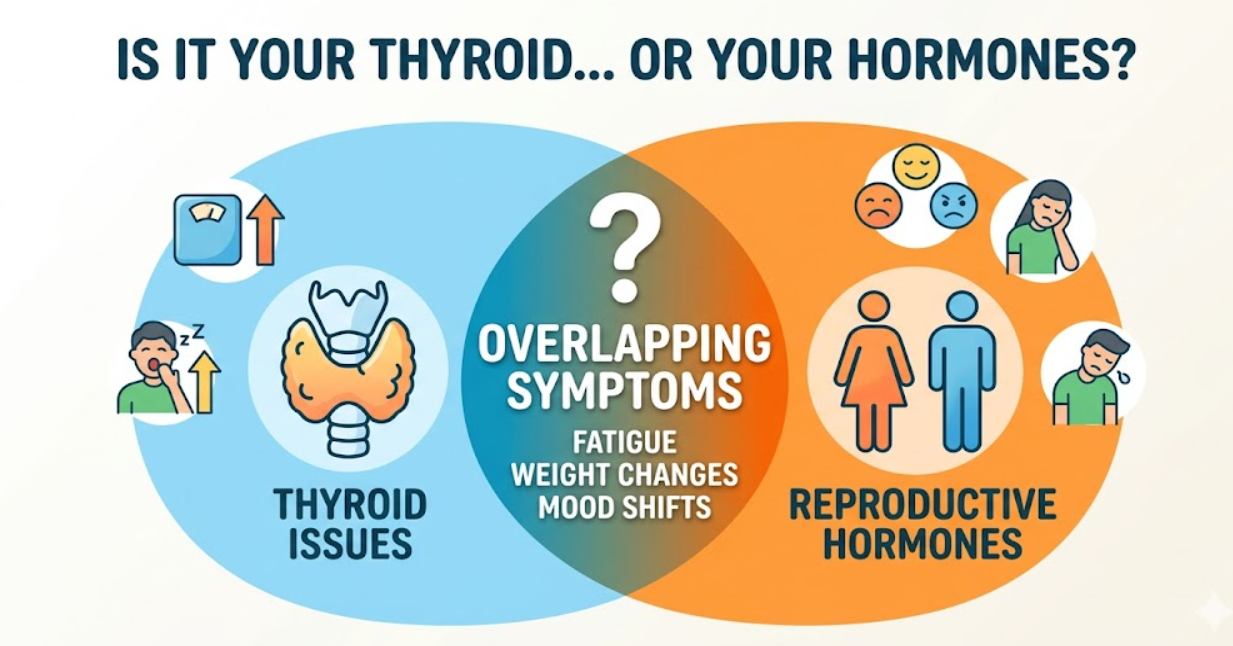
Thyroid impact: Declining estrogen affects thyroid hormone metabolism. Many perimenopausal women develop subclinical hypothyroidism, compounding their fatigue.
Studies suggest that fatigue is one of the most common symptoms of the menopausal transition, affecting a large share of women.
The Vicious Cycle
Here’s where it gets worse: chronic fatigue makes everything else harder. When you’re exhausted, you’re less likely to exercise (which would help hormone balance), more likely to reach for quick-energy foods (which disrupts blood sugar), and less able to manage stress effectively (which raises cortisol). Each of these factors further imbalances your hormones, creating a downward spiral.
The Weight Gain That Won’t Budge
Now let’s address the weight gain, because this is where women often feel the most frustrated and confused.
You’re eating the same way you always have—or even less—yet the scale keeps climbing. More frustrating, the weight settles around your abdomen in a way it never has before, creating a “menopause belly” that seems impossible to lose.
According to The North American Menopause Society, women gain an average of 5 pounds during the menopausal transition, but many women gain significantly more, and the distribution of that weight changes dramatically.
Why Perimenopause Causes Weight Gain

This isn’t about willpower or discipline. It’s about hormones fundamentally changing how your body processes and stores energy:
Metabolic slowdown: Estrogen helps regulate metabolism. As estrogen declines, your metabolic rate naturally slows. You burn fewer calories at rest than you did in your 30s, meaning the same food intake now creates a caloric surplus.
Changes in fat storage: Estrogen influences where your body stores fat. Before menopause, estrogen directs fat storage to hips and thighs. As estrogen declines, fat increasingly deposits around the abdomen—the most metabolically active and health-concerning fat distribution.
Insulin resistance: Declining estrogen increases insulin resistance, making your body less efficient at using glucose for energy and more likely to store it as fat. This also creates blood sugar swings that drive cravings and overeating.
Sleep disruption and weight: Poor sleep disrupts leptin (which signals fullness) and ghrelin (which signals hunger), making you hungrier throughout the day while simultaneously reducing your body’s ability to burn fat effectively.
Cortisol and belly fat: Elevated cortisol—common in perimenopausal women dealing with stress and poor sleep—specifically promotes abdominal fat accumulation.
Loss of muscle mass: Without adequate estrogen and growth hormone support, maintaining muscle becomes harder. Since muscle burns more calories than fat, losing muscle further slows your metabolism.
The Frustration Factor
What makes perimenopausal weight gain so frustrating is that the strategies that worked in your 20s and 30s don’t work anymore. You can’t just “eat less and move more” your way out of hormonal weight gain. In fact, severe calorie restriction and excessive exercise can actually worsen the problem by further stressing your already-struggling hormonal system.
The Sleep That Never Comes
Sleep problems might be the most underestimated symptom of perimenopause, yet they often drive all the others. When you don’t sleep well, everything else gets worse—fatigue intensifies, weight gain accelerates, mood plummets, and stress tolerance disappears.
What’s Happening to Your Sleep
Perimenopausal sleep disruption takes several forms:
Difficulty falling asleep: Despite being exhausted, you lie awake for an hour or more, mind racing, unable to shut down.
Frequent waking: You wake multiple times throughout the night—sometimes with night sweats, sometimes without any apparent reason—and struggle to fall back asleep.
Early waking: You wake at 3 or 4 AM feeling wide awake, then lie there tired but unable to return to sleep.
Unrefreshing sleep: Even when you do sleep through the night, you wake feeling unrefreshed, as if you haven’t rested at all.
Research indicates that 70-80% of perimenopausal women experience sleep disturbances, making this one of the most common symptoms of hormonal transition.
The Hormone-Sleep Connection
Multiple hormonal changes disrupt sleep:
Progesterone decline: Progesterone has a calming, sleep-promoting effect on the brain by increasing GABA (a neurotransmitter that promotes relaxation). As progesterone drops, this natural sedation decreases, making sleep more elusive.
Estrogen and sleep cycles: Estrogen influences serotonin and melatonin—neurotransmitters crucial for regulating sleep-wake cycles. Fluctuating estrogen disrupts these rhythms, fragmenting sleep architecture.
Night sweats: About 80% of women experience vasomotor symptoms (hot flashes and night sweats) during perimenopause. Waking up drenched in sweat multiple times per night obviously disrupts sleep, but even mild temperature fluctuations can prevent deep sleep.
Cortisol reversal: When cortisol rhythm is disrupted—staying high at night when it should be low—it becomes nearly impossible to fall asleep or stay asleep despite exhaustion.
How Richmond Women Are Finding Relief
Here’s the good news: once you understand that hormones are driving these symptoms, you can address the root cause rather than just managing symptoms.
Across Richmond, women who’ve spent years struggling with chronic fatigue, unexplained weight gain, and sleep problems are discovering that hormone balancing offers relief that lifestyle changes alone couldn’t provide.
Comprehensive Hormone Testing
The first step is understanding your specific hormonal picture. At RVA Optimal Health & Wellness, we conduct comprehensive hormone testing that goes far beyond basic lab work. We measure:
- Estradiol (the primary estrogen)
- Progesterone
- Testosterone (yes, women need it too)
- Thyroid hormones (TSH, Free T4, Free T3, Reverse T3)
- Cortisol rhythm (throughout the day)
- DHEA
- Additional markers as indicated
This comprehensive testing reveals not just whether hormones are “in range” but whether they’re optimal for your age and symptoms. It shows us the complete picture of what’s happening in your body.
Bioidentical Hormone Replacement Therapy
For many Richmond women in their 40s, bioidentical hormone replacement therapy provides the most significant relief. BHRT uses hormones that are molecularly identical to what your body produces naturally—not synthetic versions or animal-derived alternatives.
By restoring estrogen and progesterone to optimal levels, BHRT addresses the root cause of perimenopausal symptoms:
For fatigue: Balanced hormones restore sleep architecture, improve mitochondrial energy production, regulate cortisol rhythm, and support thyroid function—addressing fatigue at multiple levels simultaneously.
For weight gain: Hormone balance helps normalize metabolism, improve insulin sensitivity, reduce cortisol-driven belly fat accumulation, and maintain muscle mass—making weight management possible again.
For sleep: Adequate progesterone restores its natural sleep-promoting effects, balanced estrogen regulates sleep-wake cycles, and normalized cortisol rhythm allows for natural sleep and waking patterns.
According to the 2022 Position Statement from The North American Menopause Society, hormone therapy remains the most effective treatment for perimenopausal and menopausal symptoms, with the most favorable benefit-risk ratio for women under 60 or within 10 years of menopause onset.
Beyond Hormones: Comprehensive Approach
While hormone therapy is often transformative, optimal results come from a comprehensive approach that also addresses:
Sleep hygiene optimization: Even with hormone support, creating an environment conducive to sleep enhances results—dark room, cool temperature, consistent schedule, screen-free wind-down routine.
Stress management: Chronic stress works against hormone therapy. Incorporating stress-reduction practices—meditation, yoga, therapy, boundaries around work—supports hormonal balance.
Nutrition for hormone support: Adequate protein, healthy fats, complex carbohydrates, and micronutrient-rich foods provide the building blocks your body needs to produce and metabolize hormones effectively.
Strategic exercise: The right type and amount of exercise supports hormone balance. Resistance training preserves muscle mass, moderate cardio supports cardiovascular health, and adequate recovery prevents overtraining stress.
Thyroid optimization: Many perimenopausal women need thyroid support in addition to sex hormone replacement. We evaluate and treat thyroid dysfunction comprehensively.
Common Questions About Hormone Balancing for Fatigue, Weight, and Sleep
Q: Am I too young at 42/44/46 for hormone therapy?
A: Absolutely not. Perimenopause typically begins in the early-to-mid 40s, making this the ideal time to start addressing hormonal symptoms. You don’t need to suffer through years of fatigue and weight gain waiting until you’re “old enough” for treatment. If you have symptoms affecting your quality of life, you deserve evaluation and treatment regardless of your age.
Q: Will hormone therapy make me gain weight?
A: This is a common concern based on outdated information. When properly dosed bioidentical hormones are used, most women find that hormone therapy actually helps with weight management by normalizing metabolism, reducing cortisol-driven belly fat, and improving insulin sensitivity. The key is working with a provider who understands how to dose and monitor appropriately.
Q: How long before I feel better?
A: Many women notice sleep improvements within 1-2 weeks of starting hormone therapy. Energy improvements typically emerge over 4-8 weeks as hormone levels stabilize. Weight management improvements are more gradual, often becoming apparent over 3-6 months as metabolism normalizes and body composition shifts.
Q: Is bioidentical hormone therapy safe?
A: When used appropriately in women who are good candidates, bioidentical hormone therapy has a favorable safety profile, particularly for women in their 40s and 50s. We conduct thorough health evaluations to ensure you’re a good candidate and monitor you closely throughout treatment. The 2022 NAMS Position Statement confirms that for women under 60 within 10 years of menopause onset, the benefit-risk ratio is favorable.
Q: What if I’ve tried lifestyle changes and they haven’t helped?
A: This is very common. While lifestyle factors are important, they can’t overcome significant hormonal imbalance. If you’ve genuinely addressed sleep hygiene, nutrition, exercise, and stress management without adequate improvement in your fatigue, weight, or sleep, hormones are likely the missing piece. Lifestyle changes work much better when hormones are balanced.
Q: Does insurance cover hormone therapy?
A: Coverage varies by insurance plan. Many plans cover bioidentical hormones, though some require specific documentation. We help patients navigate insurance coverage and also offer self-pay options for those whose insurance doesn’t cover treatment or who prefer to keep treatment outside insurance.
Don’t Accept Exhaustion as Your New Normal
If you’re a woman in your 40s struggling with chronic fatigue, unexplained weight gain, and sleep disruptions, you don’t have to accept this as your new reality. These symptoms aren’t just “part of getting older”—they’re signs of hormonal imbalance that can be evaluated and treated.
Many Richmond women have discovered that addressing the hormonal root cause of these symptoms offers relief that years of “trying harder” with diet and exercise couldn’t provide. They’re sleeping through the night again, waking with energy, managing their weight effectively, and reclaiming the vitality they thought was gone forever.
You deserve the same relief.
Get Your Hormones Tested in Richmond
At RVA Optimal Health & Wellness, we specialize in comprehensive hormone evaluation and bioidentical hormone replacement therapy for Richmond-area women. We understand that chronic fatigue, weight gain, and sleep problems in your 40s aren’t just inconvenient—they significantly impact your career, relationships, and overall quality of life.
Tired of being tired? Frustrated with unexplained weight gain? Done with sleepless nights? Schedule your comprehensive hormone evaluation today and discover how hormone balancing can transform your life.
Our approach includes:
- Comprehensive hormone testing including estrogen, progesterone, testosterone, thyroid, cortisol, and more
- Detailed symptom assessment to understand how hormones are affecting your specific experience
- Personalized treatment plans using bioidentical hormones dosed specifically for your body and needs
- Ongoing monitoring and optimization to ensure you achieve and maintain optimal results
- Integrated lifestyle guidance to support your hormone therapy and maximize benefits
Located in Richmond and serving women throughout Central Virginia—from Short Pump to Midlothian, Glen Allen to Henrico, and the greater Richmond metro area.
Contact our team at Optimal now to schedule your consultation. Let us help you understand what’s really happening in your body and create a plan to restore your energy, normalize your weight, and reclaim restful sleep.
Your 40s should be your power decade, not your exhaustion decade. The solution isn’t pushing harder—it’s balancing your hormones. Let us show you how.
Medical Disclaimer: This article is for informational purposes only and does not constitute medical advice. Chronic fatigue, unexplained weight gain, and sleep problems can have various causes beyond hormonal imbalance, including thyroid disorders, sleep apnea, depression, chronic illness, and other medical conditions. Always consult with a qualified healthcare provider for proper diagnosis and treatment. The information provided here should not be used to self-diagnose or self-treat. Hormone replacement therapy is a medical treatment that requires professional evaluation, monitoring, and ongoing supervision. Individual results vary, and not all women are candidates for hormone therapy. Always seek the advice of your physician or other qualified health provider with any questions you may have regarding a medical condition.